How To Rank My Business On Google Ai Overview

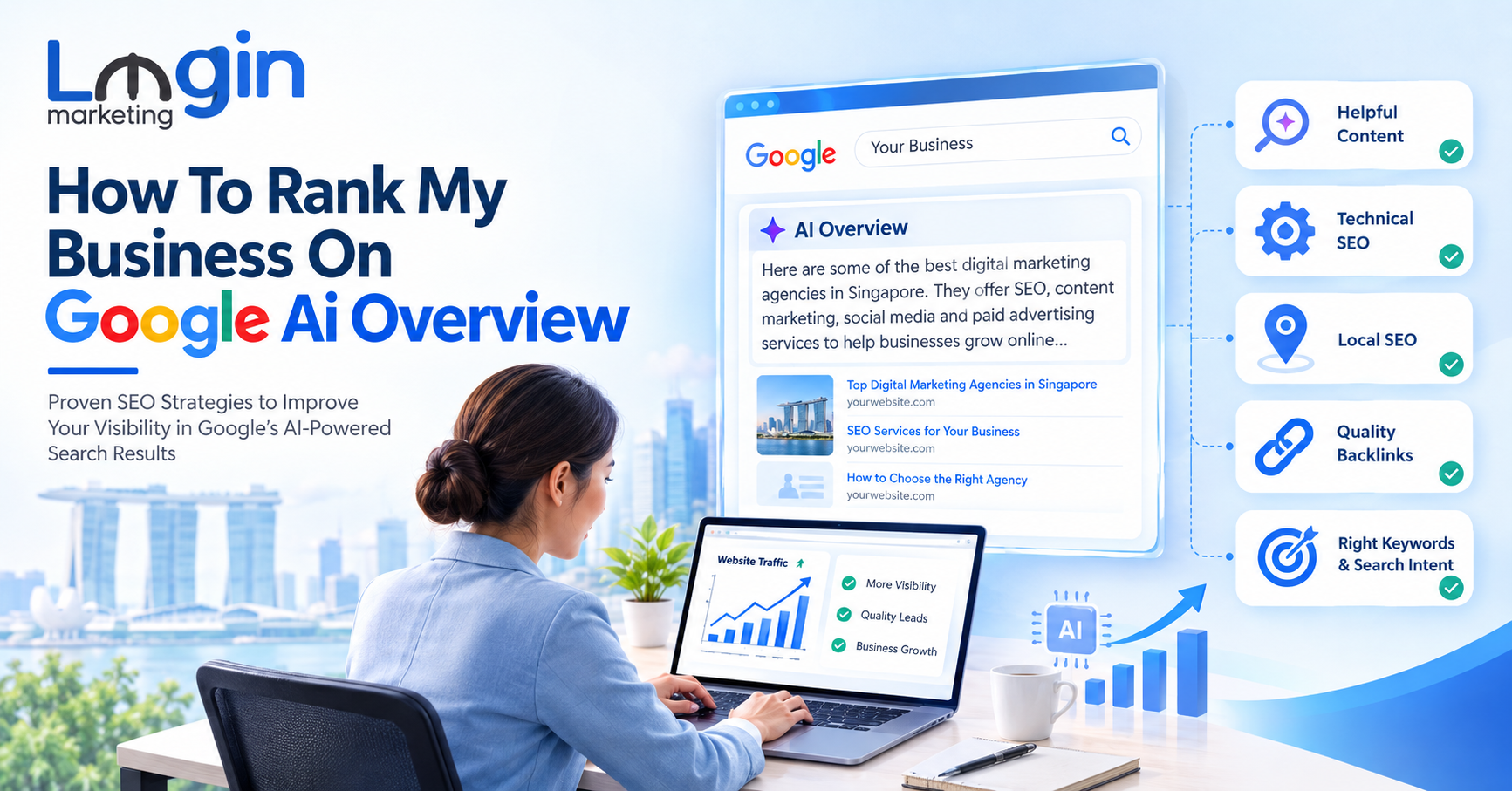
Google Search is changing the way people discover businesses, compare services, and make purchasing decisions. With AI-powered search experiences, users can find answers to complex questions through AI-generated summaries that include links to relevant websites. For businesses, this creates new opportunities to reach potential customers and build brand visibility.
If you are wondering how to rank my business on Google AI Overview, the first step is to understand that there is no guaranteed method to secure a place in these results. However, by following Google's SEO best practices, publishing genuinely helpful content, strengthening your website's credibility, and providing accurate business information, you can improve your website's overall search visibility and eligibility to appear as a supporting source.
Whether you run a local business, an e-commerce store, or a digital marketing agency in Singapore, the following strategies can help you prepare your website for the evolving search landscape.
What Is Google AI Overview and Why Does It Matter?
Google AI Overviews are AI-generated summaries that appear for certain search queries. They help users understand a topic by presenting information gathered from relevant sources, sometimes with links that allow users to explore the subject further.
For example, someone searching for the best digital marketing agency in Singapore might see an AI-generated summary discussing factors such as SEO expertise, service quality, pricing, and business reputation.
If your website provides accurate, useful information about these subjects, Google may consider your content relevant to the search. However, appearing in an AI Overview depends on Google's systems and is never guaranteed.
For businesses, visibility in AI-powered search can introduce their services to potential customers earlier in the decision-making process. Instead of focusing only on traditional search rankings, businesses should aim to become trusted sources of information that genuinely help users solve problems.
1. Create Helpful Content That Answers Real Questions
One of the most effective ways to strengthen your website's SEO is to publish content that directly addresses your audience's needs.
Think about the questions potential customers ask before choosing your products or services. These questions can become the foundation of informative blog posts, detailed service pages, comparison guides, and frequently asked questions.
For example, a Singapore-based digital marketing agency could publish articles explaining how local SEO works, how businesses can improve Google rankings, and what to consider when choosing an SEO agency.
Each article should provide meaningful information rather than repeating the same advice found across dozens of competing websites.
Best Practices for Creating Helpful Content
- Answer the main question clearly near the beginning of the article.
- Use descriptive headings to organise information logically.
- Include practical examples and actionable recommendations.
- Explain complicated topics in straightforward language.
- Support factual claims with reliable sources when appropriate.
- Update outdated information to keep your content accurate.
Avoid publishing large numbers of repetitive articles simply to target more keywords. Every page should serve a clear purpose and provide value to readers.
2. Demonstrate Genuine Experience and Expertise
Google aims to provide users with useful, reliable information. Your website should therefore make it easy for visitors to understand why your business is qualified to discuss a particular subject.
Demonstrate your experience through original insights, detailed explanations, real examples, and transparent business information.
For instance, if your company provides SEO services, explain how you approach keyword research, technical audits, content optimisation, and performance measurement. Where appropriate, share case studies that describe the original challenge, the actions taken, and the results achieved.
Only publish results that you can substantiate. If a campaign generated more organic enquiries, explain the context and measurement period rather than making unsupported claims about guaranteed rankings.
Ways to Build Trust and Credibility
- Include relevant author biographies and professional qualifications.
- Share genuine case studies and verifiable client results.
- Provide clear information about your business and services.
- Reference trustworthy sources when making important factual claims.
- Keep your website content accurate and up to date.
- Avoid exaggerated promises and unsupported marketing claims.
These elements help readers evaluate the reliability of your content and make informed decisions about your business.
3. Strengthen Your Website's Technical SEO
Your content needs a technically sound website behind it. Search engines must be able to discover, crawl, index, and understand your pages before those pages can become eligible to appear in search results.
Start by reviewing your website's technical performance.
Make sure important pages are accessible to search engine crawlers and are not accidentally blocked by robots.txt rules or noindex directives. Use Google Search Console to identify indexing issues and understand how Google interacts with your website.
Your website should also load efficiently, display properly on mobile devices, and offer a clear navigation structure.
Essential Technical SEO Improvements
- Crawlability: Ensure search engines can access important pages.
- Indexing: Monitor indexing status through Google Search Console.
- Mobile usability: Make sure pages are easy to read and navigate on smartphones.
- Page speed: Improve loading performance and reduce unnecessary page elements.
- Internal linking: Connect relevant articles and service pages.
- Site structure: Organise content into clear, logical categories.
Internal linking is particularly important. Connect related blog posts to relevant service pages so users can move naturally from learning about a topic to exploring your solutions.
For example, an article explaining AI-powered search optimisation should include a contextual link to your relevant service page. This gives readers a direct path to learn more about your offering.
Technical improvements alone will not guarantee AI Overview visibility, but they help establish the foundation required for effective SEO.
4. Optimise Your Google Business Profile for Local Visibility
If your business serves customers in Singapore, local SEO should be part of your overall search strategy.
Start by claiming and verifying your Google Business Profile. Ensure that your business name, address or service area, phone number, operating hours, website, and business categories are accurate.
Keep your information consistent wherever your business appears online.
Local SEO Strategies for Better Business Visibility
- Encourage satisfied customers to share honest reviews.
- Respond professionally to customer feedback.
- Add relevant photographs of your business, team, products, or completed projects.
- Keep your service descriptions and contact information updated.
- Build useful location-specific landing pages where appropriate.
- Maintain consistent business information across reputable directories.
For example, a digital marketing agency can explain its Singapore-based services, areas of specialisation, industries served, and approach to working with clients.
If you create location-specific landing pages, make sure each page offers genuinely useful local information rather than simply replacing a city name across identical content.
Local SEO helps Google and potential customers understand your business, although a strong Google Business Profile does not automatically qualify your website for inclusion in an AI Overview.
5. Build Authority Through Quality Backlinks and Brand Mentions
Your business's reputation extends beyond your website. Relevant mentions, editorial references, and quality backlinks can help establish your presence within your industry.
Focus on earning recognition through useful resources and genuine professional relationships.
You could publish original research, share practical industry insights, contribute expert commentary to relevant publications, or create comprehensive guides that other websites may find worth referencing.
For example, an article containing original findings about SEO challenges faced by Singapore businesses may attract attention from industry publications or business communities.
How to Earn Relevant Backlinks Naturally
- Publish original research and useful industry resources.
- Create detailed guides that answer important customer questions.
- Contribute expert insights to relevant publications.
- Develop professional relationships within your industry.
- Share genuine business achievements and original findings.
- Focus on relevant, editorially earned links rather than link quantity.
Avoid buying backlinks to manipulate search rankings, participating in link schemes, or creating fake reviews and artificial brand mentions. These practices can damage your reputation and may violate Google's spam policies.
The objective is to develop a credible online presence that reflects your actual expertise and the value your business provides.
6. Use Structured Data Correctly
Structured data helps search engines interpret information about your website and its content.
Depending on your website, appropriate schema types may include Organization, LocalBusiness, Article, and BreadcrumbList. Select markup that accurately describes the information available on each page.
For example, Article schema can help identify an article's headline, author, and publication details. Organization schema can describe relevant information about your company.
Structured Data Best Practices
- Use schema markup that matches your actual page content.
- Ensure structured data reflects information visible to users.
- Validate supported markup using Google's testing tools.
- Correct errors and warnings where relevant.
- Avoid adding irrelevant or misleading structured data.
However, structured data is not a shortcut to Google AI Overview rankings. Google does not require a special AI-specific schema to appear in AI Overviews. Strong technical SEO and useful content remain essential.
7. Target Relevant Keywords and Search Intent
Keyword research helps you understand how potential customers describe their needs and what information they expect to find.
Rather than targeting only broad keywords, build your content around relevant questions, specific services, and problems your audience wants to solve.
For example, a digital marketing agency might target searches such as:
- How to improve Google rankings for a local business
- How AI Overviews affect SEO
- Best SEO strategies for Singapore businesses
- How to choose a digital marketing agency
- How much does SEO cost in Singapore?
Each keyword should lead to content that genuinely answers the corresponding question.
Some visitors are looking for basic information, while others are comparing providers or preparing to purchase a service. Address these different needs with educational articles, detailed comparisons, case studies, and clear service pages.
How to Use Keywords Naturally
Include your target keyword in relevant locations, such as the page title, main heading, introduction, and appropriate sections. Incorporate related terms when they improve clarity, but avoid keyword stuffing.
Organise your content around the subject rather than repeating the same phrase unnecessarily. Use specific examples, explain related concepts, and answer follow-up questions that readers are likely to have.
The goal is to satisfy the user's query comprehensively, not to repeat a phrase as many times as possible.
8. Make Your Content Easy to Understand and Reference
Well-organised content improves the reading experience and helps users locate important information quickly.
Use clear headings, concise paragraphs, descriptive lists, and relevant examples. When discussing technical subjects, explain unfamiliar terms rather than assuming every reader has specialist knowledge.
Where appropriate, provide direct answers to common questions before expanding on the details. This structure makes your content easier to navigate without relying on artificial formatting tricks.
Include original information that distinguishes your website from competing sources. This might involve expert commentary, practical examples, detailed explanations, or first-hand observations from your industry.
Common Content Mistakes to Avoid
- Publishing repetitive articles that offer little additional value.
- Using AI-generated content without checking its accuracy.
- Making unsupported claims about rankings or business results.
- Stuffing keywords into headings and paragraphs.
- Copying information from competitors without adding useful insights.
- Publishing outdated information without reviewing it.
Avoid creating content solely by combining information from other websites. Review existing information critically, verify important claims, and add useful insights that readers cannot easily obtain from a superficial summary.
Ultimately, the strongest content is created to help people make better decisions, not simply to attract search engine traffic.
9. Monitor Your Search Performance and Improve Over Time
SEO requires ongoing evaluation. Publishing an article is only the beginning; you should also monitor how it performs and identify opportunities to improve it.
Google Search Console can help you review organic impressions, clicks, search queries, indexing status, and page performance. Google Analytics can provide additional insights into visitor engagement, enquiries, and conversions.
Where reporting is available, examine performance associated with AI-powered search experiences. You can also periodically review relevant search queries to understand whether your business is appearing among the sources users may encounter.
Remember that search results can vary according to the query, location, language, and other contextual factors. A single manual search is not sufficient to determine your overall visibility.
Key SEO Metrics to Track
- Organic impressions and clicks.
- Search queries and landing-page performance.
- Indexing and technical issues.
- Qualified leads and consultation bookings.
- Website engagement and conversion rates.
- Changes in visibility for relevant business topics.
Track meaningful business outcomes as well as traffic. Qualified enquiries, consultation bookings, and sales can provide a clearer picture of whether your SEO strategy is attracting the right audience.
Use the findings to improve underperforming pages, address technical problems, refresh outdated content, and answer questions your audience still has.
How Login Media Marketing Can Help Improve Your AI Search Visibility
Improving visibility in Google AI Overviews requires a coordinated approach to content, technical SEO, brand authority, and user experience.
Login Media Marketing helps businesses strengthen their online presence through strategies designed around search visibility and customer acquisition.
If you want to explore how your website can prepare for AI-powered search, visit our Google AI Overview and Gemini SEO services.
A structured SEO strategy can help you identify content opportunities, resolve website issues, improve relevant landing pages, and communicate your expertise more effectively.
Whether you are starting with a new website or improving an established online presence, focus on sustainable improvements that benefit both search engines and your customers.
Conclusion
Understanding how to rank my business on Google AI Overview starts with recognising that AI search visibility is built on strong SEO fundamentals rather than a guaranteed formula.
Focus on creating helpful content, demonstrating genuine expertise, maintaining an accessible website, strengthening local SEO, and building a credible online reputation.
Make sure your content answers real customer questions and provides useful information that goes beyond what competing websites already offer. Monitor your performance regularly and improve your website based on evidence rather than assumptions.
Although no strategy can guarantee that Google will feature your business in an AI Overview, consistently delivering accurate, valuable information can strengthen your overall search presence and help potential customers discover your services.
The best long-term approach is simple: build a website that deserves to be found, publish content that deserves to be trusted, and make it easy for customers to understand why your business is the right choice.